Nokia jumps 22% after Nvidia reveals a 2.9% stake with a $1Bn investment for 6G RAN telecom infrastructure on Nvidia's AI Blackwell platform.


Nokia (NOK) $7.42
I am planning to invest in Nokia from a 3-5 year perspective around $7.25 to $7.30, hoping that the 20% pop post investment announcement from Nvidia (NVDA) will come down. It will be a slow accumulation.
Nvidia (NVDA), Nokia (NOK) Overview of the Deal
Strategic and Technological Focus Are The Long-Term 6G Goals
Development of AI-RAN systems combining Nokia’s AirScale hardware with Nvidia’s ARC-Pro accelerated platform. Nokia’s anyRAN software stack will become AI-native, improving spectral efficiency and enabling new AI-driven applications. Simply, the deluge of AI mobile applications (ChatGPT's 400Mn users on mobile) necessitates a much stronger and efficient network.
Nokia can actually gain a competitive advantage by letting customers upgrade through software cycles rather than full hardware replacements, i.e, continuous software performance upgrades similar to cloud/AI models.
Partnership allows Nokia to leverage Nvidia’s hardware roadmap (Blackwell → Rubin → successors).
Targeting AI-native network architectures for 6G, which must support intelligent, heterogeneous, autonomous devices to emphasize uplink performance, location services, security, and trust beyond traditional bandwidth delivery.
Investment View
Here are more details on the deal:
Nvidia (NVDA) announced a $1Bn investment in Nokia (NOK), the Finnish telecommunications company that provides network equipment and software. As part of the deal, Nokia will adopt Nvidia’s new telecommunications hardware that is designed for artificial intelligence.
Nvidia CEO Jensen Huang from the CTC conference:
“We’re going to create, for the first time, a software-defined programmable computer that’s able to communicate wirelessly and do AI processing at the same time,” said Nvidia CEO Jensen Huang onstage at Nvidia’s developer conference in Washington, D.C. “Let me provide some context. We are at the outset of the AI super cycle, and AI traffic is growing exponentially. In fact, if we just look at ChatGPT, nearly half of their over 800 million weekly users access the service via mobile devices. That means networks are already carrying AI workloads, workloads that are more variable, more uplink intensive, that's the connection from the device to the network and more computationally demanding than ever before. Our goal is to make wireless communications more energy-efficient,” he said.
Equity investment 5G Advanced and 6G
The Nvidia partnership involves a $1 billion investment for a 2.9% stake in Nokia, focused on jointly developing AI-powered “Radio Access Networks” (AI-RAN), data center networking, and enabling next-generation 5G-Advanced and 6G mobile networks using Nvidia’s AI platforms.
Long-Term 6G Network Development Focus
This is a great and promising long-term strategic partnership, mid-term revenue potential is uncertain because the RAN (radio access network) market is expected to remain extremely price competitive. Unless Nvidia and Nokia manage to disrupt it with significant product differentiation or energy efficiency, most of the rewards from this will accrue after several years.
Non Exclusive: I don’t see it as a negative, Nvidia needs to sell more systems as 6G gets adopted, and it also helps Nokia by ensuring that the investment is spent wisely in R&D and Capex.
Nokia's management loves it as an AI native hardware and software solution
From the strategic partnership call, Nokia’s CEO
If you think about our stack today, today, we have a solution called AirScale. What we don't always talk about is AirScale is really two things. It's a hardware platform and a software stack that sits on top of it. We call that software stack anyRAN. With this announcement, we'll be making anyRAN AI native. And that means a few things. So, first of all, it means that we will run on an accelerated computing platform, the NVIDIA ARC-Pro platform that they've announced today. And that will provide an alternative for customers. We believe that that's a compelling alternative because we can now use AI to drive performance improvements, spectral efficiency gains potentially and create new applications and opportunities leveraging AI. In addition, that stack over time can become completely AI native. Today, it's largely deterministic in terms of its architecture. This will allow it to use AI in multiple layers in the stack. And that's what we believe is the power of this partnership. The other key thing for us is this means that we can start to deliver more value in software because now our customers don't have to take -- necessarily take hardware upgrades or work through a process like they've traditionally had to when we were in the -- in an appliance business model, which, of course, is the legacy of all network providers. Now we have a software -- more of a software-driven model. And of course, the other benefit we get is we get to ride NVIDIA's product and performance cycle. So we start with Blackwell, we go to Rubin, we continue on. And that cycle, we believe, is also virtuous because now we're on a more accelerated platform. So this gives us a lot of flexibility. And we think for customers, it gives them benefit because now we're talking about a purpose-built hardware. Jensen talked about this as being a new market they're entering into with a new platform. And that -- we also see that this is a new platform that they can then deploy.
Should we invest in the company?
Not for a short-term pop, that should be over. The stock experienced a more than 20% surge immediately after the announcement as the market reacted positively to the AI and data center narrative. However, the share price move likely discounts significant near-term upside, and tangible commercial benefits may not surface until late in the decade, especially as 6G technology is not forecast to ramp until 2030.
Longer term investors will benefit
The partnership is strategically important, positioning Nokia as a credible player in advanced AI-native infrastructure, and giving it access to Nvidia’s technology stack and ecosystem. Nokia could reposition itself as an AI leader.
Telecom infrastructure is a cut-throat, commodity, cyclical industry dominated by giants with huge capital outlays completely dependent on network upgrades. Further the entire RAN market is forecast to remain flat, with limited growth. Nokia has a huge risk of execution and a long monetization runway - perhaps an endeavor of this size will need more than $1Bn. However, the AI-RAN could be a significant growth segment within the RAN market.
From the conference call:
Analyst: Are you suggesting that by sort of modernizing telco networks using their GPUs, there's going to be a more -- a quicker upgrade cycle or replacement cycle of base stations? Management: Regarding the upgrade cycle, I think it's a bit of a different model that emerges, and it's more in line with what we see on cloud and what we see certainly in AI, which is we will continue to be able to improve the software, the application, which is the AI -- the anyRAN for AI application stack. And therefore, that -- the continued enhancements in performance will happen. It will be for the operator's choice to determine when they want to upgrade the hardware and what features they want to take advantage of. But a key thing here as we look ahead to 6G is if you think about the networks of today, largely what we're doing is treating every device consistently. There's a little bit around network slicing, applications for public safety or other priority services. But largely, we assume every device is some variant of a mobile phone. In the future, with all these intelligent connected autonomous devices and these different use cases and applications, we can't just treat the devices as homogenous. And that means we need to think about the network differently. And of course, as I touched on in my comments, the traffic patterns are different. It's no longer just streaming content or streaming rich media down to a device that's the driver of bandwidth. It's now about integrating location services, upload speeds, uplink performance and of course, trust, security, availability and transparency because for some of these devices, the connectivity is going to be essential for them to carry out their link, and that's very important.” “I think this is a market that needs innovation. It's going to be necessary to have innovation. And in fact, if you look at 5G and where innovation has happened in 5G here in the U.S., certainly, T-Mobile, our largest customer here, this is a company that has invested in their network, invested in 5G leadership, invested in technology leadership and their performance in terms of every metric, subscriber growth, profitability, market cap, the results speak for themselves.”
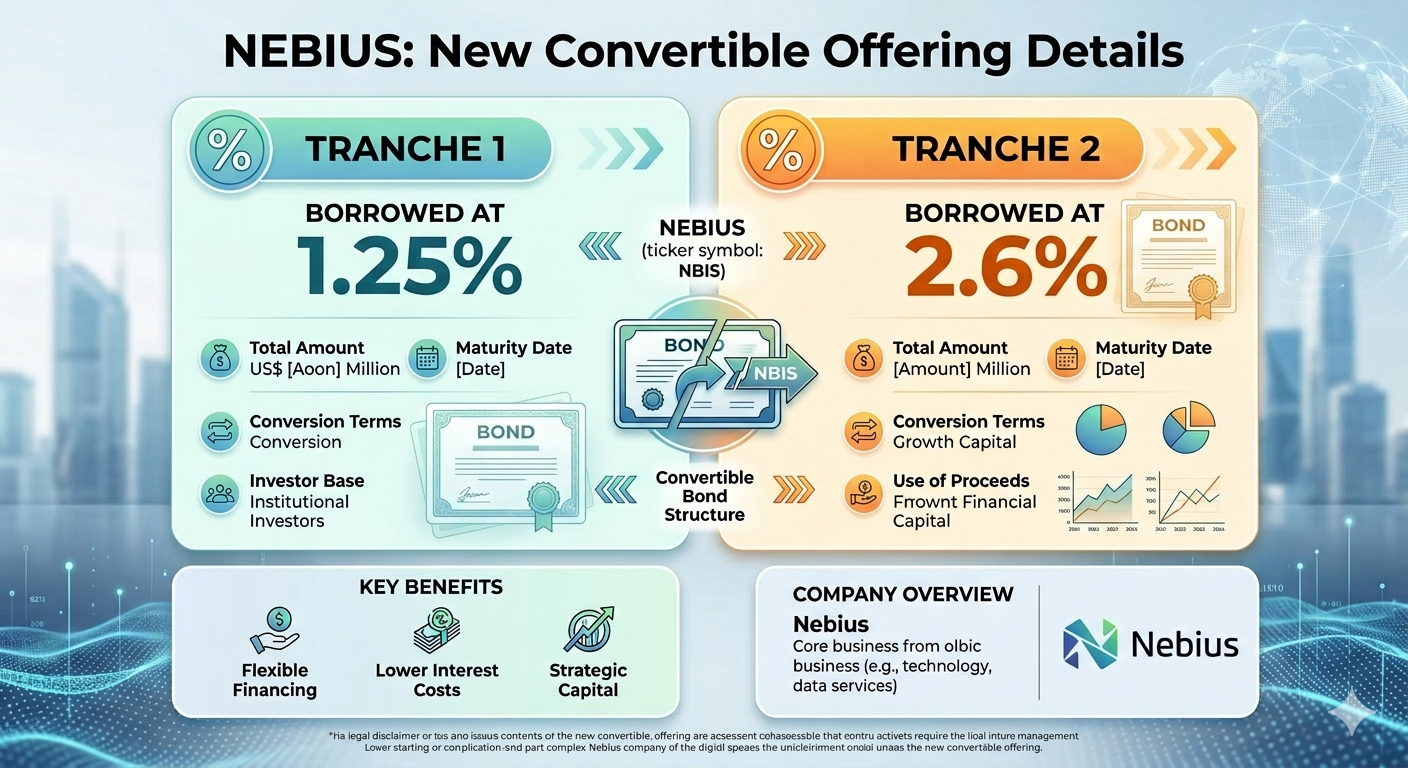
Nebius' masterly execution as an integrated neocloud player allows it to borrow at very cheap interest rates with very little shareholder dilution.
Nebius is executing brilliantly as an integrated neocloud player with tremendous reach, value addition and strong pricing power.