Nebius is executing brilliantly as an integrated neocloud player with tremendous reach, value addition and strong pricing power.
Here is the transcript, and the recording of the conference.
Company Participants: Arkady Volozh – Founder, CEO & Non-Independent Executive Director, Marc Boroditsky – Chief Revenue Officer
Conference Call Participants: Josh Baer – Morgan Stanley, Research Division
Nebius’ management and team ran one of Europe’s largest IT companies, Yandex for 25 years till 2024. The Russian-Ukraine war led to its break-up and spin -off as the Netherlands registered Arkady Volozh led Nebius that we know today. That team oversaw 200MW of data center equipment and was Nvidia’s largest partner outside the U.S. and China, which has led to an opportune entry into the booming data center business capitalizing on all its machine learning experience. In my opinion, this experience of managing gigantic infrastructure projects and bringing them to fruition is key to Nebius’ success. I also believe that this is just the beginning, and like buying Nvidia when it was just a $26Bn revenue company, three short years ago.
An integrated platform with a completely integrated datacenter, and a full software stack, much more than bare metal, allowing it to add value as “Platform As A Service” and charge a premium. Nebius builds all its layers from the ground up, from land, the power shell, the racks and integrates Nvidia’s GPUs, and then offers multi-tenant cloud solutions just like Amazon Web Services, Azure and Google Cloud - a modern fresh cloud with no legacy incumbuncy.
Arkady Volozh
But what we are building is not just gigawatts. We’re building a real platform for AI developers, a real cloud, full stack cloud. Then we integrate everything and provide the basic layer, bear metal layer, it’s called to big players and whoever wants it. We have this full stack. We recreated the full stack. We — again, we didn’t inherit any IP rights. We had to recreate it from scratch.
Sure, they will be the wholesaler to hyperscalers but the balance 50% will be directly to enterprises and independent companies, from software startups to medical behemoths all searching for the holy grail of experienced AI services, and not have to go through a hassles creating a software layer from just bare metal. Nebius will definitely benefit two ways, one taking care of capacity, and second goosing margins.
Arkady Volozh
So yes, true. Everybody talks about our big contracts, about Microsoft contract, about Meta contract, billions of dollars. And those are great contracts, and those are great customers. Big tech companies are great. There’s a lot of experience. The teams respect each other when they work together, but our focus is multi-tenant cloud for the rest. We go into these contracts because there is a huge demand from their side they need to grow faster than they can, and they outsource this growth to companies like ours and many others. But we used to be on their side before. We understand how they’re thinking. Eventually, in several years, they will be building their own capacity. They just cannot cope with the speed now. That’s why they’re outsourcing. So today, I would say it’s only roughly half and half, half of our capacity is serving these huge customers, but they buy just basic services, bear metals. They have their own stack. They don’t need our services, higher than just bare metal. We serve them. We’re happy to have them. I hope we are a good outsourcing for them, but we use this, their resources, cash, credit ratings and other things, which we use, utilize to build our own. And this is our main focus, to build our own capacity, which goes to multi-tenancy to the rest of the market to all these AI start-ups becoming corporations, as they grow, all the enterprise market going into AI and building into their processes. This is our main market. And we’re building for them.
The game plan with the multi-talent cloud means added billing for security, storage, managed databases, token generation and inferencing services, which are key to revenue creation and growth. Nebius’ Token Factory will their growth engine, which is already growing faster than training. This will also give them first mover advantages as the go-to inferencing vendor. As CEO Arkady Volozh puts it its working in three vectors - customers that are using their platform, customers using inferencing platforms built on Nebius; and of course Token Factory.
Arkady Volozh - emphasis, mine
But on top of it, there is a lot of services for — specific for AI builders like our Token Factory, inferencing platform or agentic search services, which people who build AI need, It’s agents running humans today. That’s the inferencing at the end of the day, is the commercial realization of the functionality somebody is delivering. Inferencing is growing faster than training on our platform. And we’re seeing it along three key vectors: customers that are using our platform to do their own inferencing; customers that are actually inferencing platforms that have been built on Nebius; and then our own inferencing solution, Token Factory. Interesting vector of demand, I think some of this has been reported in the technical press, is the fact that we’re now also seeing software vendors who have built functionality on the foundational models that are looking for improved performance, quality and cost that are now diversifying their models and utilizing open source or even training their own models. And that’s opened up opportunity for us to sell our inferencing solution in the software vendor sector. We believe this line of demand is going to continue into the enterprise and be a key way that we’re going to potentially be able to service enterprise requirements.
Nebius initially started with just 25 megawatts, 18 months ago, and are already at 10x and getting to another 5 times that size. It should be at 800Mw to 1Gw by the end of the year with a pipeline already reserved for 2 gigawatts, likely to grow to 3 Gw.
While Nebius, might be tiny compared to the hyperscalers in terms of revenues, the services that are being offered, the wide number of verticals, such as pharmacy, robotics and retails and geographies such as Europe and Asia should ensure that Nebius should grow to that scale in the next 4-5 years. They have as much functionality, as they go from hundreds of GPUs to millions.
Nebius has a broad distribution and go to market strategy, growing with individual researchers, and developers to the hyperscalers like Microsoft.
Marc Boroditsky, Chief Revenue Officer
We are also implementing a very broad distribution strategy. You could say that because of our AI builder orientation, we have a right to win with AI start-ups. So this has been a big part of our success in the recent past. We do that, as Arkady mentioned, by meeting them where they are with the technical capabilities that the AI builder is looking for. That same readiness has actually won us opportunities with major software vendors that are embedding AI in their offerings. So companies like Shopify and Cloudflare. And then even more recently, we started to see opportunities with the enterprise. We believe in the fullness of time, enterprise will represent the majority of the TAM. Today, it’s relatively narrow. So we have a very focused workload-specific set of initiatives where we’re pursuing specific verticals, including health care, life sciences, physical AI, media and entertainment, retail and e-tail as well as financial services.
From its first data center in Finland, Nebius spread across to France, U.K, Iceland, the U.S, and Israel in just one year. Besides increasing compute power the choice to set up multiple sights all over the country ensures that it works as a de-risking strategy should there be delays in one site or if sites get cancelled.
Arkady Volozh
This was the first example, Independence, Missouri. It’s 800-megawatt, expandable to 1.2 gigawatt. We build — continue building in Europe. Majority of what we build now is in U.S., but we build not only in Europe and the U.S., we are now opening our offices in Middle East. Singapore and Korea and Japan there as well. Today, we have 16 something locations announced. Again, it’s a pipeline. It’s like 10, 20 is already announced, and it’s in, I don’t know, a dozen of different markets. All the sales machine works for it. And for the customers, it’s just a cloud.
Like the rest of the datacenter compute market, the demand for Nebius also exceeds supply, not just because they’ll have a pipeline, excess demand is fetching them prepayments and not just from hyperscalers it is coming from smaller companies as well. These prepayments are extremely useful because it helps with Capex and keeps interest costs and dilution down. Nebius’ biggest challenge in 2026-2030 is a massive capex spend to get to 5GW of capacity, and to get there they plan to spend at least $16Bn in 2026. ASP’s increased by 50%. The other important factor is the opportunity to grow with the customer and grow the customer’s business and revenues as a strategic partner.
Marc Boroditsky, Chief Revenue Officer, emphasis mine.
The opportunity for us is actually to optimize our model to be able to build a high-margin, durable long-term business to take our abilities to generate expanding pipeline and drive the future capacity decisions that Arkady just mentioned a moment ago is the vision. Today, we have so much demand that we have to actually prioritize. So we’re taking the initiative to shift away from a transactional mindset to a value-based and solution selling approach. Our sellers spend time with customers, learning about near-term and long-term requirements, understanding how our capabilities tie to their business opportunities.
We use that in order to be able to prioritize customers that actually align against our business model. And as a result, we are now driving sale of future capacity at an increasing rate. We’re also delivering longer contract terms. As a matter of fact, the last quarter, we shared that quarter-on-quarter, the number of year-long contracts doubled. We also saw a 50% expansion in ASP, and we saw prices go up even on older generation GPUs. Now we’re also — and we haven’t shared this yet, but we’ve added it to our set of priorities, we’re now securing upfront payment from customers, up to and including, in some cases, customers paying 100% upfront. So based on this principles-based approach, we’re able to prioritize the kinds of customers, the kinds of deals that we’re looking for that support the overall business model that we’re going for. Now you asked about demand. What really excites me about demand right now is actually how we grow with our customers. Customers that have landed on our platform to start with a small project and then expand with us over time. Some customers are doubling quarter-on-quarter. They’re expanding the use cases that they have on our platform. But what really gets exciting is when they actually move to revenue generation. And then we’re actually winning and growing with them at the same time. and that is a durable opportunity for us that actually will extend into the future.
Nebius already has 50% of that number at the end of February from its two hyperscaler contracts and other clients. They remain confident of achieving that number by year end. For 2025, they had initially forecast an ARR of $900Mn to $1.1Bn, and they ended up with $1.25Bn, which means they were billing $1.04Mn in December 2025. They have visibility of achieving it from going to market strategies and from increased usage from existing customers who are taking even more compute than planned. They’ve also expressed confidence that Token Factory will generate more revenue in 2026, by providing customers developer tools and helping customers create models, which will increase the total addressable market and selling prices.
This is an integrated operation from the site, which is built and owned, not leased, saving on huge leasing margins, and then racks, which they build from scratch, saving more margins. Plus they started with their own capital and sold convertible notes in 2025 for excellent prices. They also got Microsoft’s credit rating as a bonus. Last but not least. they add value on these by providing integrated services like storage and other service which are a lot cheaper for customers.
Nebius’ plans to build an AI builder community of 1Mn builders by 2027 is a terrific strategy, which will have a phenomenal flywheel and network effect for their platform and entire AI ecosystem, similar to what CUDA managed to achieve for Nvidia. Nebius is solidifying its sales teams to arm enterprise customers for the newer AI workloads, security and compliance - this is a huge priority because workloads, protocols and processes will be significantly different in the AI era.
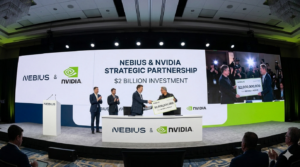
Nebius announced a $16Bn to $20Bn Capex guide for 2026, which is about 20% on data center build out and 80% on GPUs. The $2Bn investment from Nvidia should ensure enough supplies of Vera Rubin GPUs.
It believes it can manage 60% from existing opportunities including prepayments from customers. Since they have no bank obligations this is another avenue or asset backed financing that could be explored.
This is its foray into agentic AI. Tavily will help them compete with hyperscalers like Alphabet and Microsoft as it utilizes web search and a global index for checking data queried across LLM’s. The vast majority of the markets don’t have a search index and Tavily will help give it to Nebius’s customers.
I’m been long Nebius for a little less than a year and I continue to add on declines. It remains a Strong Buy.