Meta will do well with Muse, and become a market leader in Agentic AI tools for the consumer, but along the way will spend a lot, loading up on debt and equity.

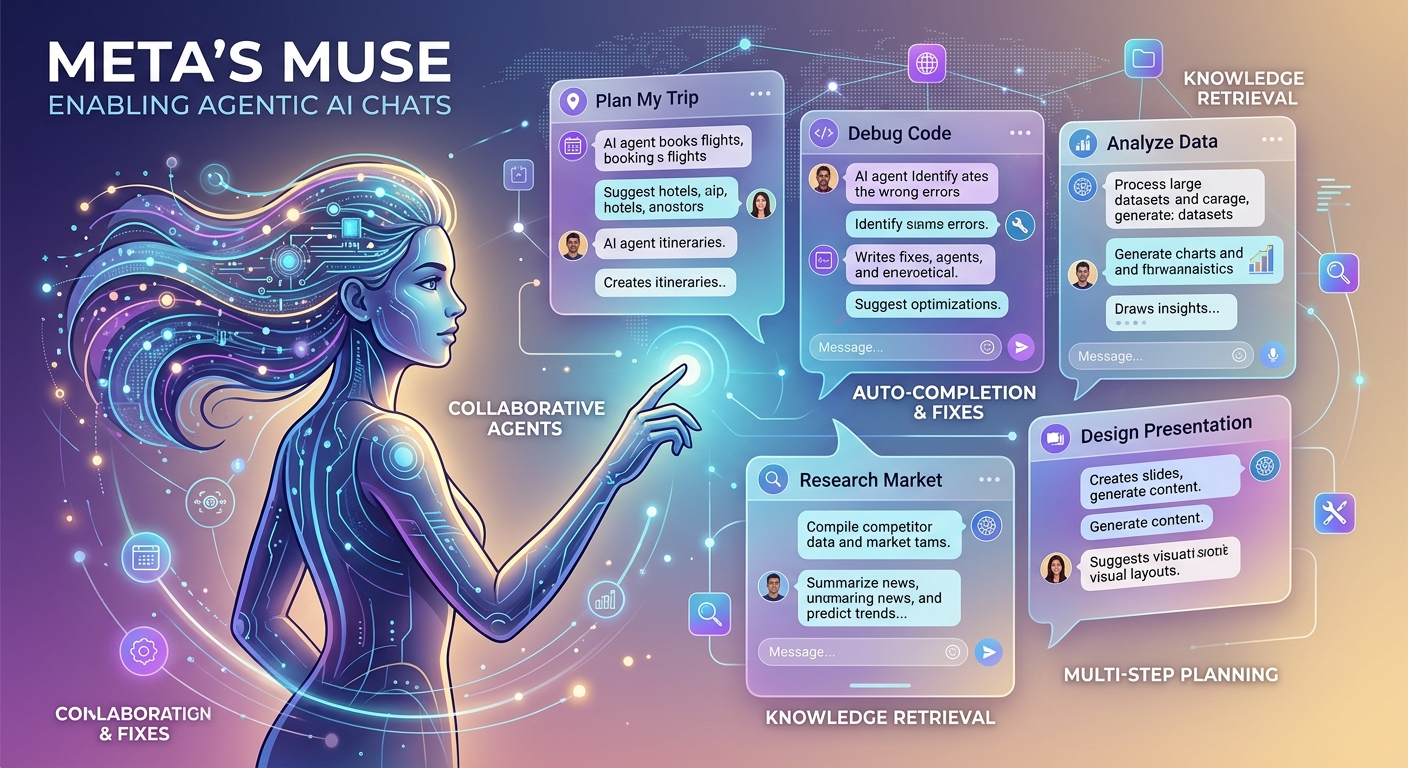
As hyperscalers and foundational models rush to get new AI products to retail and business customers, they have to provide product differentiation, and at least for now the differentiation is simply more compute. When a customer is given the power of inference - simple example, travel booking - it involves more steps than searching Kayak or a Google query. When Muse launched, it offered agentic AI services to retail customers - that was a big hit, more than 10Mn signed up in less than a month. Agentic AI is the industry term for steps done by the AI agent on your behalf - another example, using Claude code to fix website problems or changes - it will identify the steps and complete them on your behalf, with a lot of iteration (the iteration is expensive).
Meta had procured a lot of excess compute capacity for the last two years for its FB/Instagram needs and put it to use for Muse, but it is expensive because it's more compute - inference by definition means more tokens being generated. The token is the command/query sent to the GPU/cloud service provider for solving, and because of the GPU shortage and massive demand, neoclouds and clouds are charging very high prices, probably gouging - Nebius is auctioning services to the highest bidder. Some providers are even making use of Nvidia’s 6-7 year old GPUs for less intensive tasks.
What makes this even more difficult is that this is being provided at a fixed price or free, which means that companies like Meta have to either convince customers to either pay up or upsell where the variable component makes some marginal profit. That will take time and the competition is intense, possibly in a few months the agentic AI from Gemini might get better.
In their commercial segment they sell APIs on a usage basis, and recover the variable cost of running the tokens, thankfully this segment is roughly 60-70% of their total revenue. The second way is the professional monthly $200 fee per user, which recovers a good percentage of their spending, the $20 monthly loses a lot but it shuts down when the client has passed limits. Claude basic is a loss leader like Muse, but given the “compute” Muse is offering, I would think their loss per subscriber is way higher. Yesterday, we saw in the webinar how their margins had reduced and their cash flow was negative for the first time. This is likely to get worse till there is an inflection point.
Meta sank yesterday even after excellent results from its core businesses because it has very categorically and firmly decided to go full tilt into providing AI subscriptions as the end game. Actually, they have been saying this for a long time and every quarter, there’s some surprise, but that’s just how markets react…
The Class C voting shares will raise a lot of money, and they’re not shy about raising debt either. They want to grab capital, and debt before Alphabet and the others do.
I don’t think any of the big tech companies will walk away from the AI business, SpaceX, META, Alphabet, Anthropic, OpenAI, Amazon - I’m not convinced the current pie is big enough for all of them. (I’m sure in the long run the nature of the industry will change - agentic AI will get better, and add more tasks, physical AI and other sectors of the economy will add more revenue streams in the next decade)
During the internet boom, Amazon got a pass for almost a decade of losses while it was scaling - I’m skeptical about 6 companies getting a pass, especially for that long. There has to be a shakeout of some dimensions.
I would bet that Meta survives because of the wide reach and profitability of its other businesses, and I also think that their offering will be good, but given the weak sentiment, proximity to the midterms and an already high exposure to this sector and the need to diversify.
I would suggest a hold for now.