HOLD - Arm is a bit overpriced at 27x sales even accounting for its monopoly in mobile SoCs, and growing importance in power saving CPUs. A risky product strategy could derail the stock.

Arm Holdings (ARM) is the largest CPU architecture producer in the world with a virtual monopoly in the mobile CPU market with 99% market share because of its power saving "heterogenous compute" design and RISC architecture. This design lowered power requirements by enabling different CPU parts to work together for improved efficiency, alternating workloads between high and low performance CPU cores to lower energy usage. What’s even more impressive is that this leadership hasn’t been threatened in a decade, and is now allowing ARM to take on its biggest clients - CPU heavyweights AMD (AMD) and Intel (INTC)
ARM caters to all the big data center clients - powering both Nvidia’s (NVDA) Grace and Vera CPUs, as well as custom CPUs from Amazon (AMZN), Google (GOOG) and Microsoft (MSFT). Its clients have benefited tremendously with Google touting its Axion CPUs that can offer up to 65% better price-performance and 60% better energy efficiency versus x86 alternatives, while Microsoft’s Cobalt 100 and Amazon’s Graviton4 CPU both have shown significant performance and price-performance advantages over competing x86 products.
Arm’s major strategic shift - capturing inference and agentic volumes: Arm is moving beyond selling architecture IP and is now entering physical silicon and rack-scale system design for the first time, directly competing with some of its customers and with x86 CPU vendors. ARM plans to make CPUs for itself as it sees Agentic AI powering the CPU market. It believes that Agentic AI should raise the importance of CPUs, because orchestration, tool calls, API requests, and memory handling create a new bottleneck between GPU inference steps. That means future AI clusters may need a much higher CPU-to-GPU ratio than chatbot-era systems did.
ARM makes the case that CPUs can account for a large share of workflow latency, so demand for x86 CPUs from AMD and Intel is tightening, with higher pricing and long lead times cited as signs of supply strain.
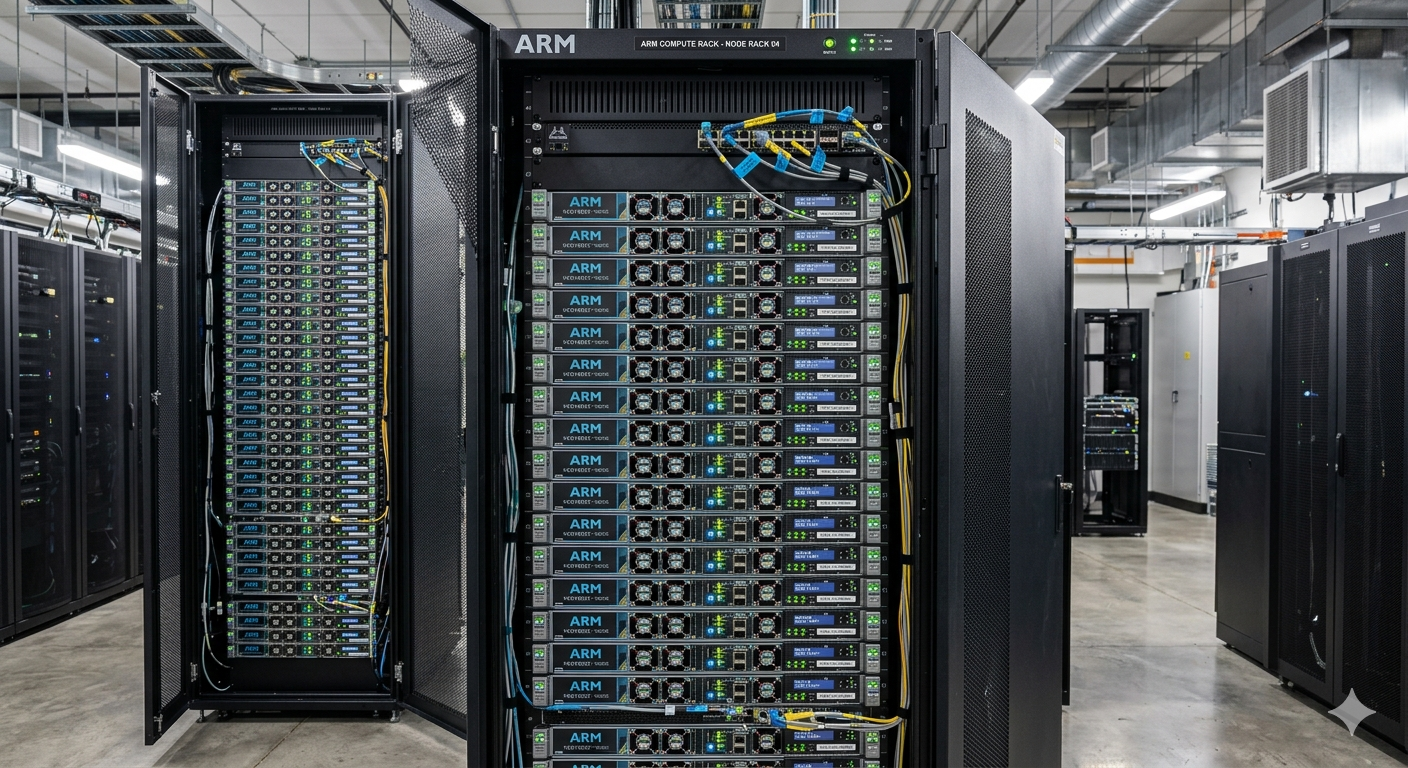
Landing a customer: Arm’s new AGI CPU is aimed at AI data centers and agentic workloads, with Meta (META) as the first customer. Arm says the chip is designed to deliver high performance while staying power-efficient, which is a key Arm advantage. Arm says the chip can reach up to 136 cores per CPU, around 2x performance per rack versus x86 in its internal estimates, and up to $10 billion in capex savings per gigawatt of AI data-center capacity.
The company is positioning the chip at the rack level, including air-cooled and liquid-cooled configurations, to improve utilization and reduce CPU-side bottlenecks that can leave GPUs underused.
Arm emphasizes low-latency design, large memory capacity, and support for CXL/PCIe connectivity so the CPU can work flexibly with different accelerators, including Nvidia and AMD GPUs or custom chips.
Arm believes that it could build a sizable new revenue stream from merchant CPUs, with management reportedly targeting $1 billion in revenue in FY2027–FY2028 and a longer-term path toward much larger revenue by FY2031.
Arm’s licensing and royalty business with 25% operating margins would still be a strong cash cow powering this venture with recurring revenue, and growing annual contract value
ARM is valued at a nosebleed 70x earnings and 27x sales. It does have a solid combination of recurring IP revenue, efficiency advantages, and exposure to a major AI infrastructure shift, but at this price, there is very little left to appreciate and I would wait for a decline to buy decent quantities and not chase the stock, unless one could wait for earnings to catch up with the stock in about a year.