Credo's AECs products have given it a commanding presence in data center connectivity, with excellent growth, making it a strong buy.


I had recommended data center connectivity stalwart, Credo Technologies (CRDO) a short 8 months ago at just $46, and the stock passed $200 today in a blazing run up on phenomenal revenue and earnings growth.
Revenue expected $335Mn to $345Mn vs consensus of $247.60M - that is an insane beat of 37%, clearly Credo has our measure, analysts should have seen Nvidia's networking revenue growth in its quarter to get a handle of where Credo was going. Note, this is a tiny less than a $1Bn in sales company and it realistically should not be profitable and yet its guiding for GAAP profits! GAAP gross margin expected between 63.8% and 65.8%, and non-GAAP gross margin expected between 64.0% and 66.0%
The stock was up 14-15% after hours and is steady today at $198.
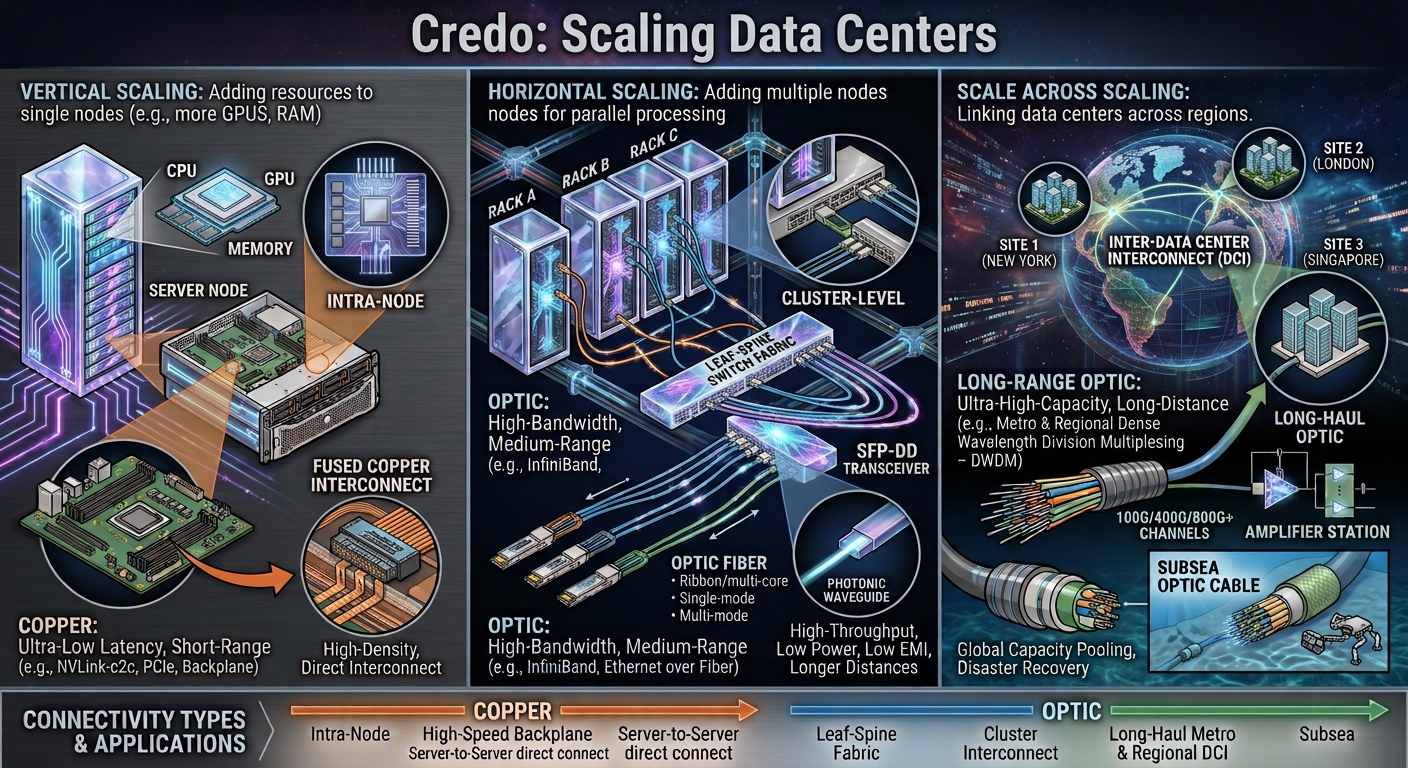
It has turned out to be quite the whale in a smallish sub sector of data centers with something as innocuous as copper wire. Credo makes AEC's Active Electric Cables from copper, which connect GPUs at short distances up to 7 meters, for scaling up, especially for Nvidia's NVlink Blackwell systems, reducing latency, improving connectivity at a much cheaper cost than optical cable and leveraging cheaper and faster copper with retimers at both ends.
Why is this not a commodity business - Can't other mass scale copper cable producers do so? Similar to the way Arista Networks (ANET) got its start working with hyperscalers, Meta Platforms (META) and Microsoft (MSFT) at the blue print stage, Credo is now leveraged across five hyperscalers working as a strategic collaborator from the ground up, differentiating itself, on reliability, signal integristy, latency and reach and now has the first mover and switching cost advantage, which should allow it to stay entrenched continue to grow for at least another 3-5 years before its get crowded and margins get suppressed. This segment has big players like Astera Labs (ALAB) with emphasis on optic cables, Marvell (MRVL) and Broadcom (AVGO); as long as data center continues to boom, Credo is assured of growth with good margins. As management mentioned on the earnings call:
At 100 gig per lane today and 200 gig per lane tomorrow ZeroFlap AECs deliver up to 1,000x better reliability than traditional laser-based optical modules while consuming roughly half the power. Again, reiterating that if you have got a single link flap in, say, 10,000 or 100,000 or 1 million GPU cluster, it brings the entire cluster down because there's no redundancy from that NIC to tour connection. And so we're actually seeing the TAM expanding. And I think for the first time in history that you're seeing copper replacing optical connections. So we're quite bullish on the market generally.
Expanding their total addressable market by taking some share from optical connections, by expanding from the traditional 3 meters to 7 meters.
When you're installing a 100,000 GPU cluster, link flaps can delay time to stability and time to revenue. And when you're training a model costing tens of millions of dollars, link flaps can have a significant impact on overall uptime and productivity. It is this step function improvement in reliability and power efficiency that's driving the expansion of the AEC TAM in the 100 gig and now 200 gig per lane generations. And we expect that trend to continue as customers densify racks and push cluster scale to new levels.
Going beyond the scaling up to scaling out and back end - this is the really fiber optic territory and Credo's collaboration with hyperscalers is allowing them to provide solutions in scaling out. To elaborate, scaling up is literally vertical when you're connecting a single node within a single or cluster of racks - like the NVLink 72 Blackwell, which combines 72 Blackwell 300 GPUs. In dense AI clusters, the distance between GPUs and the high-speed switch that connects them (often a Top-of-Rack or Spine switch) can exceed the reach of low-latency passive copper (DAC) cables, which top out quickly at high speeds. AECs provide the necessary 5–7 meter reach while maintaining the low latency and cost-efficiency of copper, which is essential for tightly coupled Scale-Up performance.
Scaling out is horizontal - Distributing a workload across many independent systems (nodes), often spread across many racks or even the entire data center floor. This forms the network fabric.In a typical Scale-Out leaf-spine network, AECs are used to connect switches to switches across adjacent racks. This allows data center architects to use high-density, copper-based links for mid-range connectivity (3–7 meters), saving the much more expensive and power-hungry Active Optical Cables (AOCs) for the long-haul runs (e.g., connecting far-flung spine switches).
There are three new growth initiatives for 2027-2028, which Credo has been working on for about 18 months and feel confident that these will yield revenue in 2027-2028, gearing up to a $5Bn revenue in the next several years.
CEO Bill Brennan had this to say on the earnings call:
Our ZF optics solutions expand our addressable market to any length of connection within the data center. We anticipate initial revenue in fiscal '27 and long term, a market that will be a multibillion-dollar opportunity. We plan to sample the first ALC products to lead customers during our fiscal '27 with initial revenue ramping in fiscal '28. We believe the ALC TAM will ultimately be more than double the sizes of the AEC TAM.” OmniConnect - Weaver allows designers to move to commodity DDR memory and achieve up to 30x more memory capacity and 8x the bandwidth. We anticipate initial revenue in our fiscal '28 with significant scaling thereafter.”
Analysts have blown up their older projections with 170% YoY growth and Daniel Fleming, Chief Financial Officer had this to answer, emphasis mine:
Yes. We -- so in my prepared remarks, I specifically said mid-single digits revenue growth sequentially through fiscal '27. So that's the expectation that we've set. We set that expectation probably 3 or 4 quarters ago as well if you go back and look at things, and we've outperformed that. So sure, things could change, but we're not setting any expectation that's different from...
With that in mind I'm increasing my revenue forecast for FY2027 to $1.8Bn, growing at 47% , and earnings to $4.50 per share growing at 60%. That prices Credo at 19x sales and 42x earnings. It is on the steeper side, but I would be surprised if Credo didn't retain its premium. I own shares and plan to ride this beast for the next 5 years.